

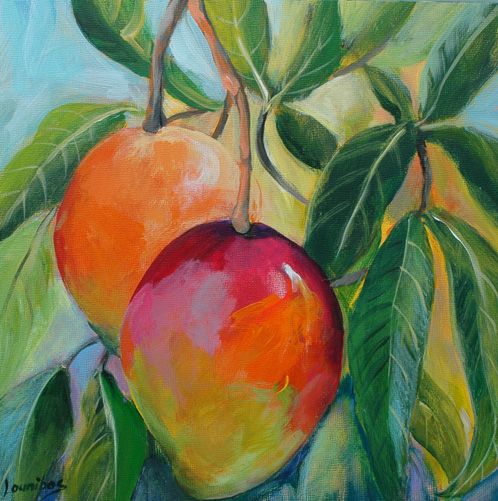
For me, mangoes have always been associated with the summer. Those sweltering lazy afternoons or the sun soaked evenings with my mouth full of sweet juice. What forms an inevitable part of my summer memories is something surprisingly versatile, and also the national fruit of India. Mangoes originated some 30 million years ago, hailing from Myanmar and Bangladesh, and then traced their path to Southern India, where from “Amra– Phal” they became known as “Aam-Kay or Maamkay” in Tamil. Ancient India saw the names of mangoes being distributed as titles to the rich and noble, a connection that can be made with Ampra-Pali, the renowned nagarvadhu or courtesan of Vaishali. Even Alexander took a truck load back with him when he returned to Greece.
This being established, mangoes are a rich component of our culture, and in their versatility, we find something that resembles the diversity of our own country today. From the thousands of dialects and languages, to something as simple as changing rituals and customs, India has and always shall be a multicolored patchwork quilt, each little square that makes a single quilt so unique in its own coloring and design.
Now the king of fruits itself has about 1500 subjects, that is to say, there are over a thousand different kinds of mangoes. Dissecting some of its main types further, we start with “Alphonso” or Hapus, named after Alphonso de Alburquerque, the Portuguese viceroy. It’s mentions were discovered in texts such as the Upanishads and even Mauryan inscriptions in the 15th century, as a part of the Columbian Food Exchange, and today, it is preferred because of its soft insides, that can be squeezed easily in your hands and all that goodness just sucked right out of it. In their invariable deliciousness, it makes sense that the Portuguese wanted to cart these treasures to Europe. In their stubbornness for doing so, Jesuit Priests were even commanded to experiment on mango plants so that firmer varieties could be plated on tables and even exported with greater ease. These formed the sub- varieties of the Alphonso, and were known by many different names. I’ve always thought of the mango family as this large family tree, its branches extending inexplicably in several directions, multiplying throughout the years. Fed by the fondness of consuming the mango, one can only imagine the mania it must have created all the way back then.
Dussehri owes its safekeeping to the Nawabs, and its first trade to Awadh or modern day Uttar Pradesh. It was used as a method of socializing in royal families, where they hosted “mango parties” and there, a variety of mango known as Shamshul Asmar, literally meaning the ‘sun’ was named so because an aristocrat deemed it’s skin to “glisten like the sun”. Chausa, too, has an interesting folklore spun around it. The story runs that the tree bearing this variety was in the courtyard of a widow, who nurtured it. Now when wealthy zamindars or landowners got their hands on it, they paid the women a hundred rupees initially, indulging in a sort of intra-town secret trade. As such, it was never traded out of town for a long time. When a commoner finally discovered it, it was only then that chausa gained its popularity.
All this proves that India traded and experimented with mangoes, and blossomed because of it. In the several offspring and viable varieties, we have found little stories that enrich our souls till date. It doesn’t end here, however. Mangoes themselves were devoured in so many different ways in different regions distributed amongst different classes and people. From plucking them straight off the trees and enjoying them raw, to aam ras or even fajeto, which is a Gujarati porridge, as well as mango rasams from Karnataka. From jams, salads, ice creams, sweet kheers, there are so many different combinations with the exciting and common prospect of using mangoes. The field just keeps getting more and more innovative.
Taking aam ras or the “essence of life” for example, which hails from Gujarat or Maharashtra, it is made from the pulp of the Aplhonso, and for generations it was believed that the juice only gets a velvety texture if the mangoes used to make it are home-grown. Moreover, it wasn’t consumed outside of households, either. The exterior of the mangoes were massaged to soften the pulp and then soaked in cold water before refrigerators came into the picture.
Picture this. A couple of lovely chartreuse- mustard mangoes just floating in their own heavenly scents, a pair of firm hands kneading their bodies, fingertips pulsating through all the way inside, really shaking up that flavor, the chunks of pulpy mass. Then rolling them across the countertops, before peeling it by hand, the fingernails scraping those peels neatly. The ras finally prepared is soft and thick. Comforting. It reminds you of home on a June afternoon.
Not only were Indians diverse in their culture, we were also quick on our feet to find solutions to our problems, and therefore we mastered the art of jugaad.
It is still preferred to peel the mangoes and extract the pulp instead of using grinders, according to several food bloggers. Another interesting point to note is a culture clash of sorts. The Mahrashtrians prefer a much thicker or pulpier texture, whereas Gujaratis like their aam ras silky smooth.
In conclusion, when we weigh mangoes against diversity, the uncommon comparison brings a host of questions to mind. Mangoes have deep roots, just like Indians. They’ve had their fair share of traveling and oppression, just like Indians. Mangoes have large families and complicated, generational stories, just like Indians. There are so many varieties of them, just like Indians. Mangoes are a rich fruit with a lavish past and filled with sweet culture. Just like Indians.
When you eat a mango, you don’t think “diversity”. But diversity isn’t only about our vast differences that we spend ages countering, but about the small things that bring us together. Mangoes.